Mostrar mensagens com a etiqueta Afeganistão. Mostrar todas as mensagens

domingo, 18 de dezembro de 2022

Afeganistão

د افغانستان اسلامي امارت

امارت اسلامی افغانستان

Os vales verdejantes escondidos pelas áridas montanhas que calcorreiam o território do Afeganistão.


Imagens retiradas da Internet.

Fontes:
https://i.pinimg.com/originals/ff/29/12/ff2912b0e89301d965da531ebc45a7ff.jpg
https://udayton.edu/magazine/2021/08/images/2108_afganistan_island.jpg
http://sunnionline.us/english/wp-content/uploads/2021/10/DSC_6696-1024x684-1.jpg

sexta-feira, 2 de dezembro de 2022

Impressões

کندهار
قندهار

Kandahar, Afeganistão.
Uma cidade fundada em 330 antes de Cristo, por Alexandre o Grande, citada pelos historiadores João de Barros e Diogo de Couto na  obra "Da Ásia", 1496-1570.*


As ruas vão mudando, os edifícios vão sendo destruídos. Mas continuam inteiros dentro de você. Chega um tempo, eu acho, que você vai olhar em volta sem conseguir reconhecer nada.”
Caio Fernando Abreu


E uma imagem antiga que data do início do século XX, com a antiga muralha que protegia a cidade.


Imagens retiradas da Internet.
Fontes:
https://www.wdl.org/en/item/11523/view/1/1/

*Origem da toponímia.
Livro:
https://purl.pt/7030
https://books.google.pt/books?id=BPlgAAAAcAAJ&q=Jo%C3%A3o+de+Barros+scandar&pg=PA6&redir_esc=y#v=onepage&q&f=false
Década IV, Livro VI, capítulo I:


quinta-feira, 30 de dezembro de 2021

Último

Os agricultores trabalham os campos junto à famosa escarpa afegã esculpida com vários nichos com representações de Buda que datam do IV e V séculos, em Bamiyan.


Imagem retirada da Internet.

Fonte:

https://www.instagram.com/p/CVe7GP2IqKH/
Fotografia de Steve McCurry, 1992.

domingo, 25 de julho de 2021

Panjshir, Afeganistão.

Cinco Leões
پنجشیر


Na província de Panjshir, no Afeganistão somos confrontados com uma natureza em ebulição indiferente aos conflitos impostos pelos humanos, que outrora em tempos de paz, desenharam os campos, em torno do rio.


E os vales permanecem intocados às notícias cantadas pelo mundo ocidental.

Imagens retirada da Internet.
Fonte:
http://setodah.blogspot.com/2011_05_08_archive.html

terça-feira, 30 de março de 2021

Os minaretes de Ghazni

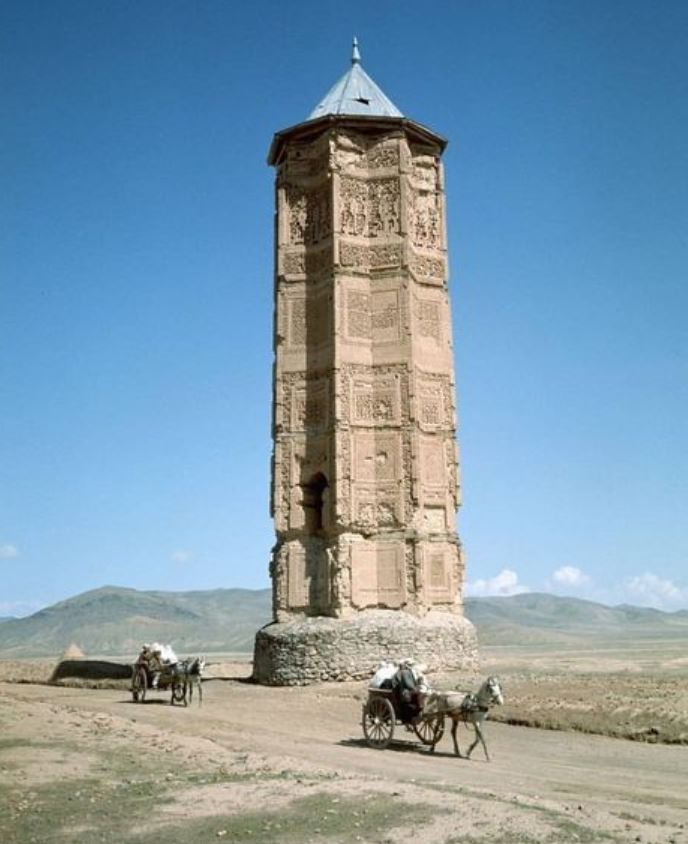
Próximos à cidadela de Ghazni, dois minaretes sinalizavam a antiga mesquita, entretanto desaparecida.
Uma pintura de 1839, de James Atkinson, representado os dois minaretes mandados erigir por Bahram Shah no início do século XII.


Uma ilustração de Charles Thompson Mathews, em1896.


Uma fotografia de 1939-1940 por Annemarie Schwarzenbach.


Fotografias de 2010 e de 2011 que retratam o minarete nos nossos dias, solitário, tendo perdido a altura inicial, mantém a imponência no território, comandando-o como um farol de luz.


Na sua indefinição encontramos algumas possiveis explicações:
"The minarets erected by Ghaznavid Sultan Mas'ud III (reign: 1099-1115) and his son and successor Bahram Shah (reign: 1117-1157) stand 600 meters apart on a plain to east of their capital Ghazni, near the Palace of Mas'ud III (b. 1114)." The easternmost minaret was built by the Mas'ud III; the other was raised by Bahram Shah, whose reign ended with the sacking of Ghazni by Alauddin of Ghor. According to Archnet: "Both minarets — which served as models for the spectacular tower of Jam which in turn inspired the Qutob Minar at Delhi — once rose to a height over forty-four meters; their cylindrical upper halves have collapsed, leaving their lower stelliform shafts." Now only a fraction of their original height (only the first story is still standing), the minarets are capped with modern tin roofs.

According to Nancy Dupree, "the intricate decoration of minarets is in raised brick, without color, and includes epigraphic friezes in square Kufic and Naskh script in addition to panels with floral and geometric designs. Mounds of ruins at the foot of both minarets indicate that they were once a part of two large buildings. Evidence from these mounds supports the theory that these buildings were mosques." [Dupree, N., An Historical Guide to Afghanistan, Kabul, 1977, p. 182]

The lack of archaeological studies has left their function uncertain; they may have been built as victory towers, or as minarets accompanying mud-brick mosques
." *


Todas as imagens foram retiradas da Internet.
Fontes:
https://en.wikipedia.org/wiki/Ghazni_Minarets#/media/File:The_story_of_architecture-_an_outline_of_the_styles_in_all_countries_(1896)_(14766244092).jpg
*https://web.archive.org/web/20160402173629/http://www.cemml.colostate.edu/cultural/09476/afgh05-072.html

segunda-feira, 29 de março de 2021

Ghazni, Afeganistão

Numa viagem no tempo em busca da quase perdida cidadela construída em adobe no Afeganistão, que remonta ao século XIII.

Uma pintura de meados do século XIX de James Rattray:


"This lithograph was taken from plate 18 of 'Afghaunistan' by Lieutenant James Rattray. This sketch was made near some mosques outside the Kandahar Gate to the west side of Ghazni, a city Rattray visited several times. Ghazni had enjoyed its principal moment of glory 800 years earlier when it was the capital of an empire extending from the Armenian mountains to the fertile plains of the Ganges. Rattray wrote that it was now again well-known, "thanks to our love of territorial aggrandisement, and the occasional desertion of war's fickle deity from our ranks". He described riding slowly over a wide plain, dotted with relics of past ages, to Ghazni: "Interspersed with this havoc of centuries, as far as the eye could reach, were a succession of rich groves, vineyards, flower-gardens, melon-beds and orchards [while] in the blue distance, its white structures just discernable from the mountains it springs from, rested Ghuzni, with its bastions, town and citadel." On 6 September 1842, Ghazni was for a second time wrested from the Afghans by the British under General Nott. On taking possession of the city, the engineers were given two days to blow it up. When Rattray last glimpsed it, "far-famed Ghazni was a heap of smoking ruins"."


Três registos do ano 1939-1940:


Um registo sem data:

Um registo de 2011:

Tudo se desmorona, tudo tem um tempo… a eternidade na arquitectura é igualmente perecível e frágil.
Um registo de 2013 (talvez):


Imagens retiradas da Internet.
Fontes:
https://www.bbc.com/news/world-asia-22124146
https://en.wikipedia.org/wiki/Citadel_of_Ghazni

domingo, 28 de março de 2021

Afeganistão

Minaret of Ghazni.

Numa viagem pela história do  Afeganistão, descobrimos a antiga cidadela de Ghazni e um minarete de tijolos que resistiu às mudanças na região. Desde o século XII, que assiste às mais variadas transformações deste território, desde guerras a mudanças climáticas.


Imagem retirada da Internet.
Fonte:
https://www.pinterest.pt/pin/145593000439369945/

segunda-feira, 30 de novembro de 2020

Último - As muralhas de Kandahar

Afeganistão
A cidade de Kandahar no Afeganistão era protegida por uma imponente muralha, que se recortava com delicados desenhos. 

Nesta fotografia podemos assistir ao acampamento das forças armadas, numa batalha que deu origem à vitória dos britânicos, junto às muralhas, no final do século XIX, cerca de meio século, antes de serem derrubadas pelo rei Nadir.

"Outside the Kandahar Citadel (locally called "Arg"). The men sitting and standing (and looking at the camera) are mostly camp followers of the British forces from then British India (now Pakistan, India and Bangladesh). The precise location where this photo was snapped is the backside of today's Kandahar Governor House, looking toward the direction of the Baba Saab area in Arghandab. The British military operation was conducted in that area on 1 September 1880 to defend Kandahar from the army of Ayub Khan (son of Sher Ali Khan and cousin of Abdur Rahman Khan), who was supported by then Persia and Russia against British India. Ayub Khan and his army had come from Herat. Based on how the men are dressed, this photo was likely created before or after the 27 July 1880 Battle of Maiwand."*


Tudo se repete em ciclos cada vez mais invasivos e violentos… Já Eça de Queiroz nos explicava no seu livro - Cartas de Inglaterra: 
"No entanto a Inglaterra goza por algum tempo a «grande vitória do Afeganistão» com a certeza de ter de recomeçar daqui a dez anos ou quinze anos; porque nem pode conquistar e anexar um vasto reino, que é grande como a França, nem pode consentir, colados à sua ilharga, uns poucos de milhões de homens fanáticos, batalhadores e hostis. A «política», portanto, é debilitá-los periodicamente, com uma invasão arruinadora. São as fortes necessidades de um grande império.“ 

Imagem retirada da Internet.
Fonte:
* https://en.wikipedia.org/wiki/Battle_of_Kandahar#/media/File:Forces_from_British_India_camping_at_Kandahar.jpg

segunda-feira, 31 de agosto de 2020

Último - Cabul

کابل
Cabul, a capital do Afeganistão, num registo de Sir Keith Alexander Jackson, que serviu no 4º Regimento Leve dos Dragões no exército britânico, parte da força anglo-indiana que saiu da Índia Britânica e marchou em direcção ao Afeganistão em Dezembro de 1838, aquando da Primeira Guerra Anglo-Afegã [1839 a 1842].


Descrição da cidadela e do palácio do rei:
"Caubul is about 6000 feet above the level of the sea; it is the capital of Affghaunistãn, and the residence of its king. The city is surrounded on the three sides by fortified hills, at the foot of which flows the river Caubul. The Bala Hissar or Citadel commands the town, and contains the palace of the King which is a venerable building in a dilapidated state. In the northern parts of the building, the apartments are lofty, and not devoid of splendour, but for lack of care and attention many of them are fast falling to decay. Within the inner court in the garden, laid out in terraces, walks and parterres containing also some splendid pavilions, and a large fountain. The streets of the city are irregular and confined, and the river, which in this part is shallow and narrow, divides the principal portion, on the right, from lesser on the left: the latter is mainly composed of detached dwellings, gardens, orchards, &c. The tomb of the Emperor Baba is situated in one of the most delightful spots in the neighbourhood, about a mile from the town; [...]"


Os mercados da cidade:
"Caubul is celedrated for the excellence and extent in bazaars, the principal of which is the Charchutta, 600 feet in length and 30 in width, consisting of four arcades, which contain nearly two thousand shops, [...]"

Uma breve descrição das casas:
"The houses of Caubul are principally built of wood and sun-dried bricks [...]"

Descrição dos habitantes, homens e mulheres:
"The male inhabitants are tall, strong, active and bold, generally handsome, with swarthy complexions, and wearing large whiskers and beards. In their dealings they are honest, and are proverbial for their hospitality. The women, who are seldom to be seen, are well formed and good stature; they are mostly of fair complexions and very beautiful; their costume is nearly the same as that of the upper classes in Persia, being a long frock of rich silk with full coloured trowsers; on their heads they wear a small cap embroidered with gold, attached to which is a large white veil to cover their heads, and to drawn over their faces on the approach of a stranger, leaving only a small opening for the eyes." 


Imagens e citações retiradas da Internet - Biblioteca Digital Mundial. 

domingo, 31 de maio de 2020

Último - Afeganistão

افغانستان
Os Budas de Bamiyan, esculpidos nas encostas que protegem o vale com o mesmo nome, entre os séculos III e V, numa região onde o budismo prosperava. Inúmeros santuários e mosteiros foram construídos durante este período assim como duas grandes esculturas representando Buda, com 55 e 38 metros de altura) hoje desaparecidas.


Afeganistão, 1931.
Esculpido na encosta rochosa, o grande Buda com cerca 55 metros de altura.

domingo, 6 de março de 2016

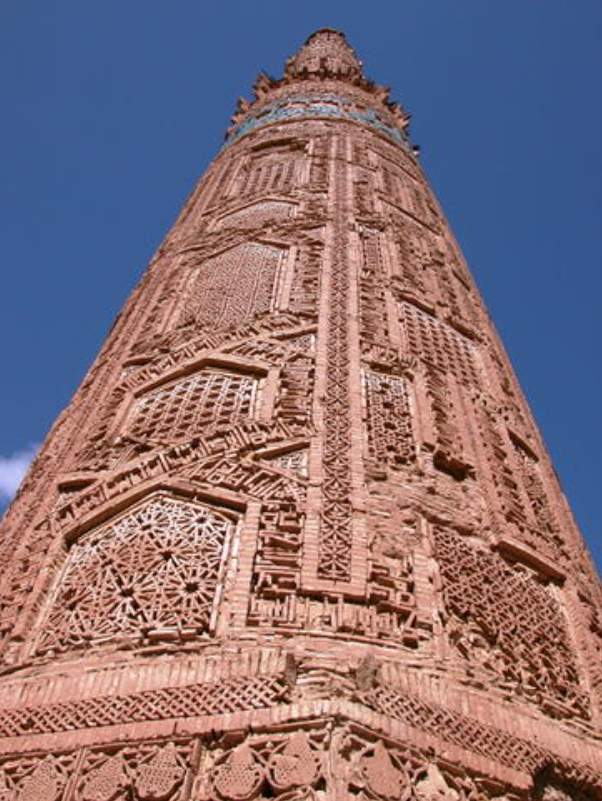
Minarete de Jam - Resolutione


Este minarete com cerca de 65 metros de altura sobreviveu estoicamente à passagem da história.
Esta construção realizada a mando do sultão Ghurid, Ghiyas-od-din (1153-1203),  no século XII, na província Ghur, no Afeganistão, representa mais uma memória de uma cultura que imperou outrora nestas terras. Pensa-se que aqui seria a localização da capital de verão Firuzkuh, da dinastia Ghurid. Como seria essa cidade?


Site da Unesco:
http://whc.unesco.org/en/list/211/

Explicação deste tema - Resolutione
http://entrepreambulos.blogspot.com/2015/12/resolutione-16.html

Todas as imagens foram retiradas da Internet.